


Rotating Cage Autoclave (RCA) Corrosion Testing
Benchmark Lab provides professional Rotating Cage Autoclave (RCA) Corrosion Testing to evaluate corrosion rates, inhibitor performance, and material behavior under controlled high-temperature and high-pressure (HPHT) conditions. In the demanding environments of the modern energy sector, static testing often falls short. Our RCA methodology bridges the gap between the laboratory and the field, providing a dynamic environment that accurately reflects the physical and chemical stresses your assets face every day.
By utilizing Rotating Cage Autoclave (RCA) Corrosion Testing, operators can move beyond simple material immersion and instead simulate the complex interactions between fluid flow, shear stress, and chemical inhibition. This level of detail is essential for ensuring the long-term integrity of infrastructure in Midstream, Salt Water Disposal (SWD), and Production sectors.
By utilizing Rotating Cage Autoclave (RCA) Corrosion Testing, operators can move beyond simple material immersion and instead simulate the complex interactions between fluid flow, shear stress, and chemical inhibition. This level of detail is essential for ensuring the long-term integrity of infrastructure in Midstream, Salt Water Disposal (SWD), and Production sectors.
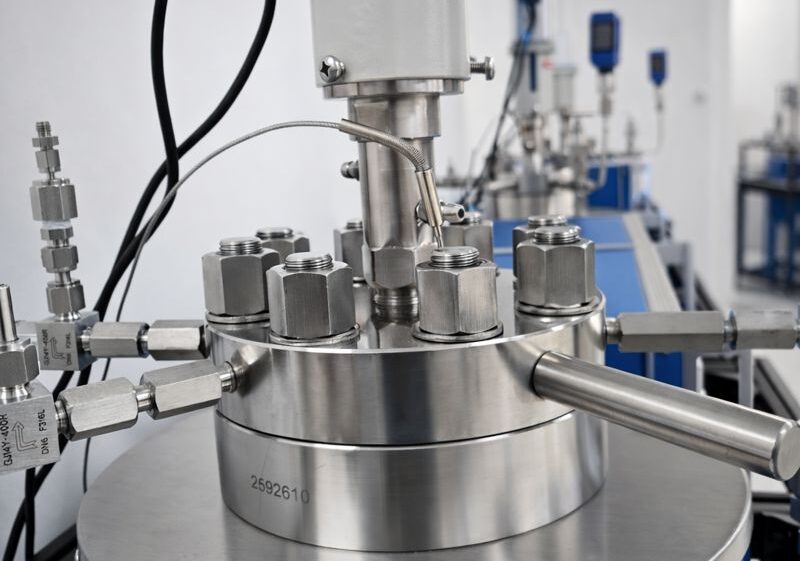
Simulating Real-World Pipeline & Downhole Environments
The Rotating Cage Autoclave (RCA) Corrosion Testing method is the industry standard for simulating environments where fluid velocity, shear stress, and pressure are the primary drivers of metal loss. At Benchmark Lab, our Houston-based facility supports programs across three primary sectors, tailoring each test to the unique challenges of the application:Midstream Pipelines:
We evaluate inhibitor persistence and flow-induced corrosion in transmission lines. For pipeline operators, understanding how an inhibitor film holds up under high wall shear stress is critical for preventing leaks and optimizing chemical injection costs.Salt Water Disposal (SWD) Wells:
We test material resilience against high-salinity produced water and corrosive gases. SWD wells often face aggressive combinations of CO2 and H2S; our Rotating Cage Autoclave (RCA) Corrosion Testing replicates these mixtures to ensure your tubing and casing are protected. •Production Oil Wells:
We simulate downhole conditions to rank chemical treatments and material compatibility. Whether you are dealing with high-pressure gas wells or heavy oil production, RCA testing provides the data needed to select the most cost-effective metallurgy and chemical program.What the RCA Test Evaluates
The Rotating Cage Autoclave (RCA) Corrosion Testing method provides repeatable and representative data essential for laboratory qualification and comparative screening. Our process goes beyond simple weight loss to provide a holistic view of material degradation: •General Corrosion Rates:
We provide precise measurements of metal loss, typically reported in mils per year (mpy) or millimeters per year (mm/y). This allows for easy comparison between different materials or chemical treatments.Inhibitor Efficiency:
We rank the performance of corrosion inhibitors under dynamic conditions. By simulating flow, we can determine the "shear stability" of the inhibitor film, ensuring it won't be stripped away by high-velocity fluids in the field. •Environmental Impact:
Our systems allow for the precise control of gas compositions, including the effects of CO₂ (sweet corrosion), H₂S (sour corrosion), and N₂ (de-aerated environments). We also evaluate the influence of water chemistry, including varying salinity levels and the presence of organic acids.Pitting Analysis:
Perhaps the most critical component of our Rotating Cage Autoclave (RCA) Corrosion Testing is the detailed 3D microscope morphology of coupon surfaces. Localized pitting is often the cause of catastrophic failure; we provide quantitative data on pit depth and density to help you assess the true risk to your assets.Standard RCA Testing Workflow
Our workflow is designed for technical accuracy and transparency. Each Rotating Cage Autoclave (RCA) Corrosion Testing program follows a rigorous sequence to ensure data integrity:1. Test Design and Definition: We work with your team to define specific parameters, including temperature (up to 350°F), pressure (up to 2,500 psi), rotation speed (to match field shear stress), and fluid chemistry.
2. Coupon Preparation: Precision is key. We perform professional cleaning, weighing, and documentation of corrosion coupons before they are securely mounted in the rotating cage assembly.
3. System Conditioning: The autoclave is charged with the test fluids and purged with the specified gases to remove oxygen and establish the required partial pressures of CO₂ or H₂S. 4. Dynamic Exposure: The core of the Rotating Cage Autoclave (RCA) Corrosion Testing involves continuous rotation for a defined duration (typically 3 to 7 days). This creates the necessary mass transfer and wall shear stress required to simulate field flow. 5. Analysis and Reporting: After a controlled shutdown, coupons are removed for final cleaning and weighing. We then perform 3D microscopy to analyze surface morphology. The final report includes all data, photographs, and performance rankings.