


Deepwater Umbilical Injection Chemical Stability Testing
Benchmark Lab provides industry-leading Deepwater Umbilical Injection Chemical Stability Testing and high-pressure viscosity analysis to support chemical qualification for offshore energy operations. As subsea production moves into deeper and more complex environments, the reliability of chemical injection systems becomes paramount. Our specialized testing services evaluate chemical stability and viscosity behavior under the exact pressure and temperature profiles representative of modern deepwater umbilical systems, subsea manifolds, and downhole injection points.
In deepwater operations, chemicals such as hydrate inhibitors, asphaltene dispersants, and scale inhibitors must travel through miles of subsea tubing. During this transit, they are exposed to extreme hydrostatic pressures and temperature gradients—from the cold of the seafloor to the intense heat of the reservoir. Even minor fluctuations in viscosity or chemical degradation under these conditions can lead to pump failure, line plugging, or loss of well control. Deepwater Umbilical Injection Chemical Stability Testing at Benchmark Lab is designed to identify these risks before they reach the offshore environment.
In deepwater operations, chemicals such as hydrate inhibitors, asphaltene dispersants, and scale inhibitors must travel through miles of subsea tubing. During this transit, they are exposed to extreme hydrostatic pressures and temperature gradients—from the cold of the seafloor to the intense heat of the reservoir. Even minor fluctuations in viscosity or chemical degradation under these conditions can lead to pump failure, line plugging, or loss of well control. Deepwater Umbilical Injection Chemical Stability Testing at Benchmark Lab is designed to identify these risks before they reach the offshore environment.
The Critical Need for Umbilical Chemical Qualification
Deepwater umbilical injection systems impose some of the most rigorous physical requirements on industrial chemicals. To ensure operational integrity, chemicals must remain stable, pumpable, and viscosity-consistent throughout their entire residence time within the umbilical. Deepwater Umbilical Injection Chemical Stability Testing is the primary method used by operators to qualify new formulations and verify that they will not undergo pressure-induced thickening or phase separation.Our comprehensive qualification programs are used to:
• Qualify Chemicals for Service: Ensure that new chemical formulations meet the stringent physical property requirements for deepwater umbilical injection.
• Verify Viscosity Stability: Monitor how viscosity reacts to extreme pressure ramps, identifying potential "viscosity spikes" that could exceed pump capacity.
• Confirm Thermal Stability: Validate that chemicals remain effective and stable at both the near-freezing temperatures of the subsea floor and the elevated temperatures of the downhole injection point.
• Reduce Operational Risk: By identifying potential injectability issues or plugging risks in the lab, we help operators avoid multimillion-dollar remediation costs offshore.
Expanded Applications: HPHT Drilling, EOR, and Supercritical CO₂
Beyond standard inhibitor qualification, our Deepwater Umbilical Injection Chemical Stability Testing system is uniquely equipped to handle the most advanced fluids used in the energy transition and enhanced recovery:• HPHT Drilling & Completion Fluids: We evaluate the rheological stability of complex drilling fluids at pressures up to 20,000 psi, ensuring they maintain the necessary weight and lubricating properties during extreme downhole exposure.
• Polymer Enhanced Oil Recovery (EOR): Polymer solutions used in EOR are highly sensitive to shear and pressure. Our testing quantifies how these polymers maintain their viscosity profiles over long residence times in subsea injection lines.
• Supercritical CO₂ and Carbon Capture (CCUS): As the industry shifts toward carbon sequestration, understanding the stability of chemicals in supercritical CO₂ streams is vital. We test the solubility and stability of additives within CO₂ phases at high-pressure conditions.
• Existing Chemical Re-Qualification: When field conditions change—such as a tie-back to a deeper well—we re-evaluate existing chemical programs to ensure they remain safe for the updated pressure and temperature envelope.
Advanced HPHT Testing Capabilities (0 to 20,000 psi)
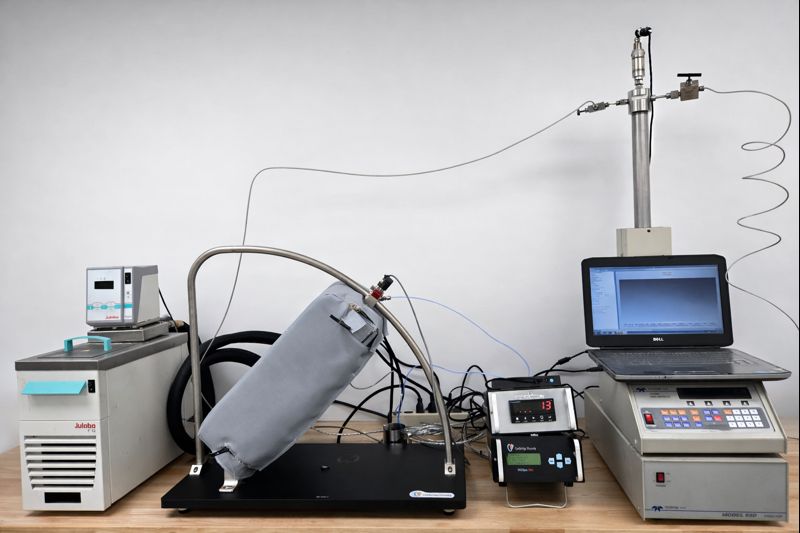
At Benchmark Lab, we utilize state-of-the-art instrumentation to deliver high-precision data. Our Deepwater Umbilical Injection Chemical Stability Testing system integrates a Cambridge ViscoPro 2000 high-pressure viscometer with precision thermal and pressure control systems.Our technical envelope includes:
• Pressure Range: 0 to 20,000 psi, supporting Ultra-Deepwater (UDW) qualifications.
• Pressure Increments: We offer 1,000 psi increments for detailed qualification or 2,500 psi increments for rapid screening.
• Temperature Control: Integrated Julabo chiller/heater units allow us to simulate the entire temperature journey from topside to the subsea environment.
• Precision Pumping: Utilizing Teledyne ISCO pumps, we maintain absolute pressure stability during hold periods, ensuring that any viscosity drift is a result of chemical behavior rather than system fluctuation.
Standard Umbilical Qualification Test Workflow
To provide the most accurate simulation of field conditions, every Deepwater Umbilical Injection Chemical Stability Testing program follows a rigorous and repeatable technical sequence:Test Design and Condition Definition: We define specific parameters, including pressure range, increments, and temperature setpoints based on your umbilical design.
System Preparation and Stabilization: The test chemical is loaded into the high-pressure system, followed by leak checks and temperature equilibration to the subsea or downhole setpoint.
Pressure Ramp and Equilibration: We perform incremental pressurization from ambient to the target pressure. At each step, we monitor for any time-dependent changes.
Extended Stability Testing (Optional): For chemicals with high residence times, we offer 24-hour stability testing. This "soak period" at constant pressure is vital for identifying long-term viscosity drift during static exposure.
Depressurization and Data Review: Once the cycle is complete, the data is compiled into a comprehensive qualification report.
Why Partner with Benchmark Lab?
Each Deepwater Umbilical Injection Chemical Stability Testing program at Benchmark Lab concludes with a professional data package including viscosity profiles from 0 to 20,000 psi and detailed temperature logs. We prioritize data accuracy and rapid reporting because we understand that chemical qualification is a critical path item for offshore projects.Choosing Benchmark Lab means choosing a partner with deep expertise in subsea chemical behavior. Our high-pressure viscosity testing provides the controlled, repeatable data that operators and chemical suppliers need to qualify products with confidence, ensuring injectability and protecting the long-term health of your subsea infrastructure.